
Core concept and policy
The UNISOL Group conducts its business activities in a spirt of respect for all human rights, including those of our business partners, officers, and employees. In order to clarify our approach on respect for human rights and help us to further promote related initiatives, we formulated our Human Rights Policy in November 2024.
Note: This Policy was debated and ratified on November 18, 2024, by the Sustainability Committee, chaired by our President and Representative Director. The Policy was reported on to the Board of Directors for oversight when it met on December 16, 2024.
Human rights promotion system
Our initiatives relating to respect for human rights are promoted through collaboration between the Compliance Committee and other related Committees and departments, and within the framework of our sustainability promotion system, in which the Sustainability Committee plays a central role.
Related link
Education and awareness
Internal initiatives
To ensure that all employees understand our commitment to respecting human rights and take appropriate action in their daily duties, we promote awareness and engagement activities across the group. Through initiatives such as annual harassment prevention training for all employees, we educate personnel on the importance of human rights, while raising awareness of our Human Rights Policy and internal reporting system, thereby driving individual awareness.
Initiatives for business partners
We communicate and share our approach to human rights with our business partners through our Sustainable Procurement Policy. By conducting survey questionnaires based on this policy with our key suppliers, we seek their understanding and cooperation regarding the importance of human rights. Through these efforts, we strive to reduce human rights risks throughout the entire supply chain and promote sustainable procurement.
Related link
Human Rights Due Diligence (HRDD)
In accordance with the UN Guiding Principles on Business and Human Rights, the UNISOL Group launched its human rights due diligence (HRDD) process in FY2025. This initiative aims to make our Human Rights Policy effective by identifying, preventing, and mitigating adverse human rights impacts within our business activities.
As the first step in FY2025, we focused on identifying salient human rights themes to assess human rights impacts and risks across the entire Group and its value chain. In implementing HRDD, we are supported by third-party organizations: Tokio Marine dR Co., Ltd. and Caux Round Table Japan (CRT Japan).
Identification of Salient Human Rights Themes (Risk Assessment)
The UNISOL Group organized and analyzed information based on external/third-party perspectives gathered through hearing sheets and desktop research, as well as internal perspectives from employee workshop discussions. The salient human rights themes were identified through the specialized analysis of third-party organizations, incorporating the inputs from the research and the workshop.
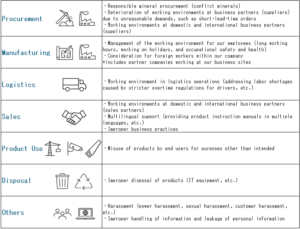
Furthermore, based on the following three factors, we evaluated which of the salient human rights themes identified in the risk assessment should be prioritized:
・High importance from third-party perspectives
・Current management status (related to the likelihood of occurrence)
・High potential for direct impact and approach through direct dialogue
As a result, we identified “Management of the working environment for our employees” and “Consideration for foreign workers within our company” as priority themes. Moving forward, we plan to ensure and expand awareness of our existing initiatives while simultaneously conducting human rights impact assessments for these priority themes.