
Core concept
UNISOL Holdings Corporation views corporate governance as fundamentally about fulfilling our responsibilities to all stakeholders and future society. To that end, we aim for cohesive Group management through agile and efficient decision-making under a fair and transparent management system, ultimately striving for sustainable growth and enhanced medium- to long-term corporate value.
Our Board of Directors is responsible for charting the strategic direction of the Group, efficiently securing and appropriately allocating Group management resources, formulating and executing capital policies, and overseeing the construction and operation of internal control systems throughout the entire Group. This allows us to accurately identify business risks within the Group and thoroughly manage overall profit and risk—contributing to the establishment of a robust Group management system.
Furthermore, we have established the Group Philosophy (our slogan, vision, mission, 3 values, and 7 standards) as the fundamental management principles shared by all employees of the Group. We will continuously work to strengthen corporate governance through the practical application of these principles.
Related links
Corporate governance structure
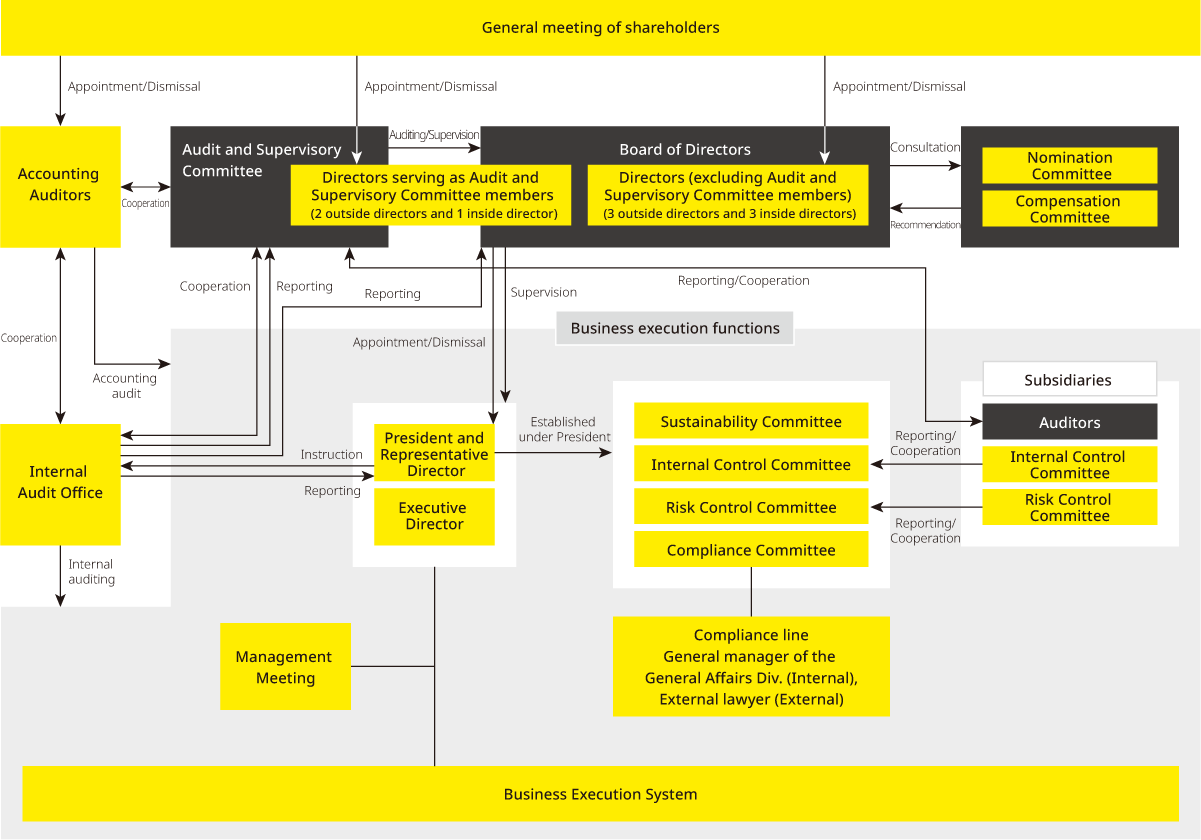
UNISOL Holdings Corporation is structured as a company with an Audit and Supervisory Committee. We have established a Board of Directors, an Audit and Supervisory Committee, and appointed an Accounting Auditor. Furthermore, we maintain the Internal Audit Office which, in collaboration with the Audit and Supervisory Committee, strengthens our monitoring functions across all daily operations.
As a corporate oversight function, we have a system comprised of one full-time Director and two Outside Directors serving as Audit and Supervisory Committee members to audit the execution of duties by Directors. Of these, the two Outside Directors on the Audit and Supervisory Committee have been appointed as independent directors, allowing them to attend Board of Directors meetings and other important bodies from a position distanced from management, thereby enhancing the effectiveness of corporate oversight.
At UNISOL Holdings Corporation, we have established a governance system where Outside Directors monitor and supervise the execution of duties by management independently and fairly, which is why we are maintaining our current structure.
Diverse officer skills
UNISOL Holdings Corporation’s officers possess knowledge and experience suited to the UNISOL Group’s wide-ranging business domains. When appointing officers, we comprehensively review candidates with reference to the range of skills possessed by our cohort of officers and the Company’s management strategy, with consideration for creating an optimal balance between execution and oversight of business.
Recognizing our fiduciary duty to shareholders, we have established “Policies and Procedures for the Appointment and Dismissal of Directors” to ensure that the Board of Directors appropriately fulfills its roles and responsibilities when appointing and dismissing both director candidates who are not Audit and Supervisory Committee members and those who are.
Our outside officers meet the independence requirements stipulated by the Companies Act and the financial instruments exchange on which we are listed, as well as our own independence criteria.
Related links
Board of Directors
Composition of our Board of Directors
We transitioned from a company with an Audit & Supervisory Board to a company with an Audit and Supervisory Committee, following approval of amendments to the Articles of Incorporation at the Fourth Annual General Meeting of Shareholders held on March 28, 2025. As of March 27, 2026, our Board of Directors consists of nine members: six Directors (excluding Audit and Supervisory Committee Members, including three Outside Directors) and three Directors who are Audit and Supervisory Committee Members (including two Outside Directors).
Subjects debated and matters reported
The chief subjects debated by and matters reported to the Board of Directors in FY2025 are outlined below.
| Subjects debated and matters reported | No. of issues |
|---|---|
| Management strategies | 14 |
| Financial results and other financial matters | 19 |
| Sustainability, governance, internal control, risk management, and compliance | 14 |
| Matters relating to the Board of Directors, Nomination Committee, Compensation Committee, and human resources | 20 |
| Matters relating to Audit and Supervisory Committee Members, internal audit divisions, and Accounting Auditors | 2 |
| Discrete cases | 33 |
Attendance
The attendance record of each Director at Board of Directors meetings for FY2025 is as follows.
| Position | Name | Attendance |
|---|---|---|
| Chairperson and Representative Director | Kunihiko Iida | 100% (12 of 12 meetings) |
| President and Representative Director | Ryohei Furusato | 100% (12 of 12 meetings) |
| Director and Senior Managing Executive Officer | Katsuhiro Yamashita | 100% (12 of 12 meetings) |
| Outside Director | Hiroyuki Nakatsukasa | 92% (11 of 12 meetings) |
| Outside Director | Junko Takechi | 100% (12 of 12 meetings) |
| Outside Director | Hisao Takahashi | 100% (12 of 12 meetings) |
| Outside Director(Standing Audit and Supervisory Committee Member) | Satoshi Onishi | 100% (12 of 12 meetings) |
| Outside Director(Audit and Supervisory Committee Member) | Kyoko Hikita | 100% (12 of 12 meetings) |
| Outside Director(Audit and Supervisory Committee Member) | Yasuo Sasaki | 100% (12 of 12 meetings) |
Audit and Supervisory Committee
The Audit and Supervisory Committee is comprised of three Directors also serving as Audit and Supervisory Committee members (including two Outside Directors). These Directors possesses expertise in management, finance, and accounting to a considerable degree.
Nomination Committee and Compensation Committee
In the aim of increasing the impartiality and objectivity of operations relating to Director nomination, remuneration, and related issues, we have established a Nomination Committee and a Compensation Committee, both under the purview of the Board of Directors and comprising a majority of Outside Directors. Both function as advisory committees and are chaired by an Outside Director.
The Nomination Committee discusses, at the request of the Board of Directors, proposals for the General Meeting of Shareholders regarding the appointment and dismissal of Directors, while the Compensation Committee discusses matters concerning remuneration of individual directors, and reports on the details of these discussions to the Board of Directors.
Composition and attendance
The composition of the Nomination Committee and Compensation Committee and attendance of both Committees’ meetings in FY2025 are outlined below.
Nomination Committee
| Name (position) | Attendance | |
|---|---|---|
| Chairperson | Junko Takechi (Outside Director) | 3 of 3 meetings |
| Members | Kunihiko Iida (Chairperson and Representative Director) | 3 of 3 meetings |
| Members | Ryohei Furusato (President and Representative Director) | 3 of 3 meetings |
| Members | Hiroyuki Nakatsukasa (Outside Director) | 3 of 3 meetings |
| Members | Hisao Takahashi (Outside Director) | 3 of 3 meetings |
Compensation Committee
| Name (position) | Attendance | |
|---|---|---|
| Chairperson | Hiroyuki Nakatsukasa (Outside Director) | 2 of 2 meetings |
| Members | Kunihiko Iida (Chairperson and Representative Director) | 2 of 2 meetings |
| Members | Ryohei Furusato (President and Representative Director) | 2 of 2 meetings |
| Members | Junko Takechi (Outside Director) | 2 of 2 meetings |
| Members | Hisao Takahashi (Outside Director) | 2 of 2 meetings |
The composition of the Nomination Committee and Compensation Committee as of March 26, 2026 is outlined below.
| Nomination Committee | Compensation Committee | |
|---|---|---|
| Chairperson | Junko Takechi (Outside Director) | Hiroyuki Nakatsukasa (Outside Director) |
| Members | Kunihiko Iida (Chairperson and Representative Director) | Kunihiko Iida (Chairperson and Representative Director) |
| Members | Ryohei Furusato (President and Representative Director) | Ryohei Furusato (President and Representative Director) |
| Members | Hiroyuki Nakatsukasa (Outside Director) | Junko Takechi (Outside Director) |
| Members | Hisao Takahashi (Outside Director) | Hisao Takahashi (Outside Director) |
Assessment of the effectiveness of the Board of Directors
In order to verify whether the Board of Directors is functioning by fulfilling its role and responsibilities, and in the aim of improving that functioning, the Company conducts an assessment of the effectiveness of the Board of Directors as a whole each business year.
The assessment method for FY2025 and an overview of the results are as follows.
Assessment method
Implementation period
December 2025
Assessment targets
All Directors (9), including Audit and Supervisory Committee members
Assessment procedure
Questionnaire survey of all Directors → Collate and analyze at secretariat → Deliberation by Board of Directors
Issues assessed by our questionnaire
The survey questions are as follows. The survey was conducted in a five-point rating scale and a free-response. The survey also ensured continuity with the previous year’s questionnaire while reflecting the transition to a company with an Audit and Supervisory Committee.
- The nature and composition of the Board of Directors
- Operation of the Board of Directors
- Deliberations of the Board of Directors
- Monitoring functions carried out by the Board of Directors
- Dialogue with shareholders and investors
- Roles and responsibilities of the Board of Directors
- Functions of the Audit and Supervisory Committee
- Support framework for Directors
- Operation of the Nomination Committee and Compensation Committee
Overview of assessment results
The results of the Board of Directors’ assessment of its own effectiveness are summarized below.
- The Board’s effectiveness has been maintained at a level assessed as “generally sufficient.”
- Following the transition to a company with an Audit and Supervisory Committee, the number of Board voting members has increased, resulting in improved diversity in terms of experience and gender.
- Support systems to enhance Directors’ expertise have been strengthened, and increased input from Outside Directors drawing on their experience has contributed to improved quality of Board discussions.
- Regarding the points identified as priority themes following the results of the previous effectiveness assessment, progress and achievements have been made as follows:
・Development and enhancement of monitoring functions
The organizational transition to being a company with an Audit and Supervisory Committee has further enhanced our awareness of monitoring, with a consequent increase in monitoring-related recommendations from Directors based on their expertise.
・Revitalization of the Nomination Committee
The Nomination Committee meets three times annually and has made steady progress in succession planning discussions.
・Enhancement of discussions on improving corporate value
The review of the Board’s approval criteria following the transition to a company with an Audit and Supervisory Committee has been largely completed, contributing to more focused discussions of higher quality. - However, there is also a view that discussions on corporate growth strategy and human capital remain insufficient, and that further strengthening of discussions—including from a risk perspective—remains an ongoing priority
- Strengthening the structure as a company with an Audit and Supervisory Committee, monitoring Group-wide business restructuring, and addressing new challenges are also essential.
Future initiatives
Based on the assessment results, we confirmed that the effectiveness of the Company’s Board of Directors is generally ensured. We also verified that some progress has been achieved with regard to the three issues identified in the previous assessment. Based on these results, active discussions are being held to further enhance effectiveness, and we will continue to move forward with initiatives for improvement.
- Deepening discussion of strategic themes
・Deepening of discussion on important themes related to foundations for corporate value creation, such as management strategy, business portfolios, and human capital management. - Further enhancing monitoring functions
・Strengthening oversight functions that utilize diversity such as enhanced coordination with the Audit and Supervisory Committee and with voluntary nomination and remuneration committees.
・Strengthening continuous monitoring by enhancing multifaceted information, including risk- and governance-related data.